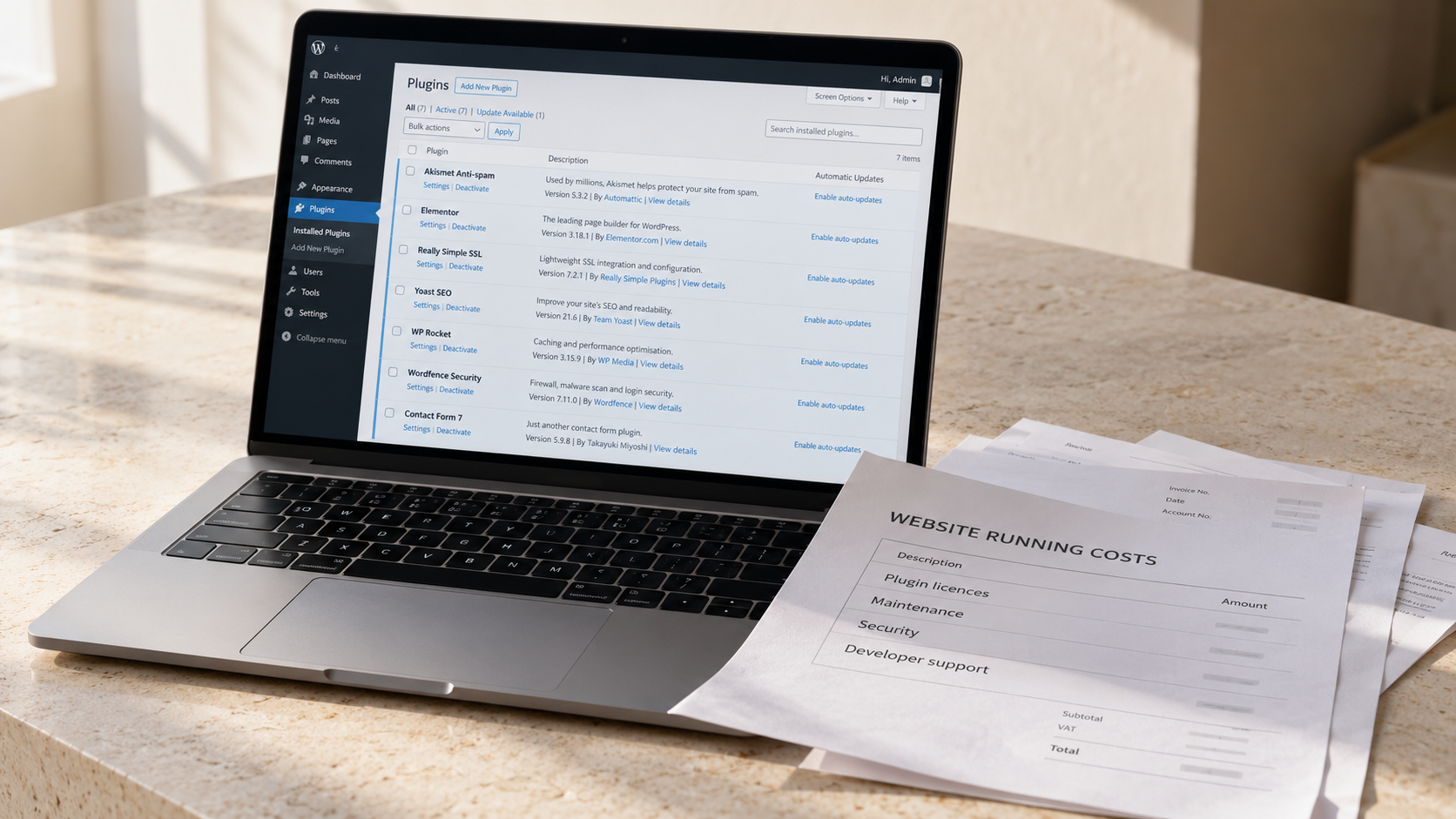
The Real Cost of your WordPress Website

Written by
on
October 28, 2026

The "cheap and cheerful" trap

‍

WordPress powers over 40% of the entire web. It's cheap to start, flexible, and there's a plugin for almost everything. It's also costing many growing businesses far more than they've ever stopped to calculate.

Most WordPress sites start with good intentions. A sensible setup, a handful of plugins, a theme that does the job. Then the years pass. A new plugin for bookings. Another for SEO. One more for forms. Someone installs a caching plugin because the site's getting slow. Another for security because someone mentioned breaches at a conference.

Before long, you're running a site that nobody quite owns. It started as a website. It became an IT infrastructure problem.

The real cost isn't the initial build. It's everything that accumulates in the years afterwards: the plugin subscriptions, the developer hours to keep it patched, the performance drag, and the security exposure that comes with managing dozens of third-party codebases stitched together.

We've just published a whitepaper on this: The Real Cost of Your WordPress Website. The data inside it is uncomfortable reading for anyone who's been told their site is "fine".

What that actually costs you

‍

Around 70% of WordPress sites run at least one vulnerable plugin, and plugins are responsible for the majority of WordPress security breaches. Security researchers logged nearly 8,000 new WordPress vulnerabilities in 2024 alone. Most SMEs have no formal process for reviewing the cyber risk posed by their website's plugin suppliers. Most don't even know how many plugins they're running.

‍

The performance picture isn't prettier. 88% of UK adults have abandoned an online purchase because a website loaded too slowly. A plugin-heavy WordPress site has more scripts loading in the background, more external dependencies, and more points of failure than a purpose-built alternative. Every second of load time is prospect leakage you'll never see in your analytics.

‍

Add up the annual plugin subscriptions (SEO tools, page builders, backup tools, security scanners) and a site that "costs nothing" can run to hundreds of pounds a year in recurring licence fees alone. That's before you factor in the developer time to keep everything updated, compatible, and running cleanly.

Why the ground is shifting now

‍

The reason most businesses reached for plugins in the first place is rapidly disappearing.

Plugins existed to save time. Writing custom functionality used to take weeks, so you bought something off the shelf instead. That trade-off made sense. It doesn't any more.

AI-assisted development has compressed timelines dramatically. What used to require weeks of custom build now takes days. Modern platforms like Webflow were built without the plugin dependency that WordPress accumulated over two decades. They offer cleaner architecture, faster performance, and one codebase to maintain, not fifty.

Agencies that built their pricing model around WordPress complexity are having to rethink. Businesses that held on to WordPress because switching felt complicated are realising the gap between where their site is and where it could be is getting wider, not narrower.

Choosing WordPress over Webflow made sense for a long time. For many businesses, that's changing.

‍

The question worth asking

‍

The question isn't "what does my website cost?"

It's "what is my website actually costing me, in maintenance, in performance, in security risk, and in the time my team spends managing it rather than growing the business?"

For most growing businesses, nobody has ever properly sat down and worked that out. Not in one place, with honest numbers, accounting for everything.

‍

We wrote it all down

‍

The Real Cost of Your WordPress Website walks through the full picture: what you're paying beyond the build, how the plugin problem compounds over time, what the security data actually shows for UK businesses, and how the alternatives stack up now that AI-assisted development has changed the economics.

‍

It's not a sales pitch. It's fifteen minutes of reading that will give you a clearer picture of where your site genuinely stands and what your competitors are already figuring out.

Download the whitepaper →

__________________________________________________________________________________________________________________________________________________________________

If you'd rather have the conversation directly, we offer a free site audit. We'll take a proper look at what your current site is actually costing you and what a leaner, faster alternative could look like for your business.

Book your free site audit →

‍